Campaigners and charities unite behind new principles to reset social media for children
[.style-intro] A new coalition of influential organisations including Smartphone Free Childhood, NSPCC and Molly Rose Foundation has agreed a shared set of principles calling for platforms’ access to children to become conditional on safety. [.style-intro]
For months, the Government – and Big Tech – have pointed to disagreement between campaigners and civil society organisations as a reason for delay or inaction on children and social media.
That has always felt frustrating to us. Because while there have often been disagreements about language, strategy and specific policy mechanisms, there has also been far more common ground than many people realise.
Over the past few weeks, we’ve been speaking with groups including NSPCC, Molly Rose Foundation and People vs Big Tech to see whether it was possible to align around a shared set of principles ahead of the Government’s upcoming decisions on children and social media.
Today, we’ve agreed them.
And importantly, they include a principle that would have been very difficult to get broad agreement on until recently:
If platforms aren’t safe for children, they shouldn’t have access to children.
In practice, that means today’s social media companies could not continue serving under-16s unless they made fundamental changes to how their platforms work.
In many ways, this is a more future-proof approach than simply banning individual social media apps.
Rather than focusing on a few specific platforms, it establishes a universal principle: any platform that wants access to children must first prove it is safe.
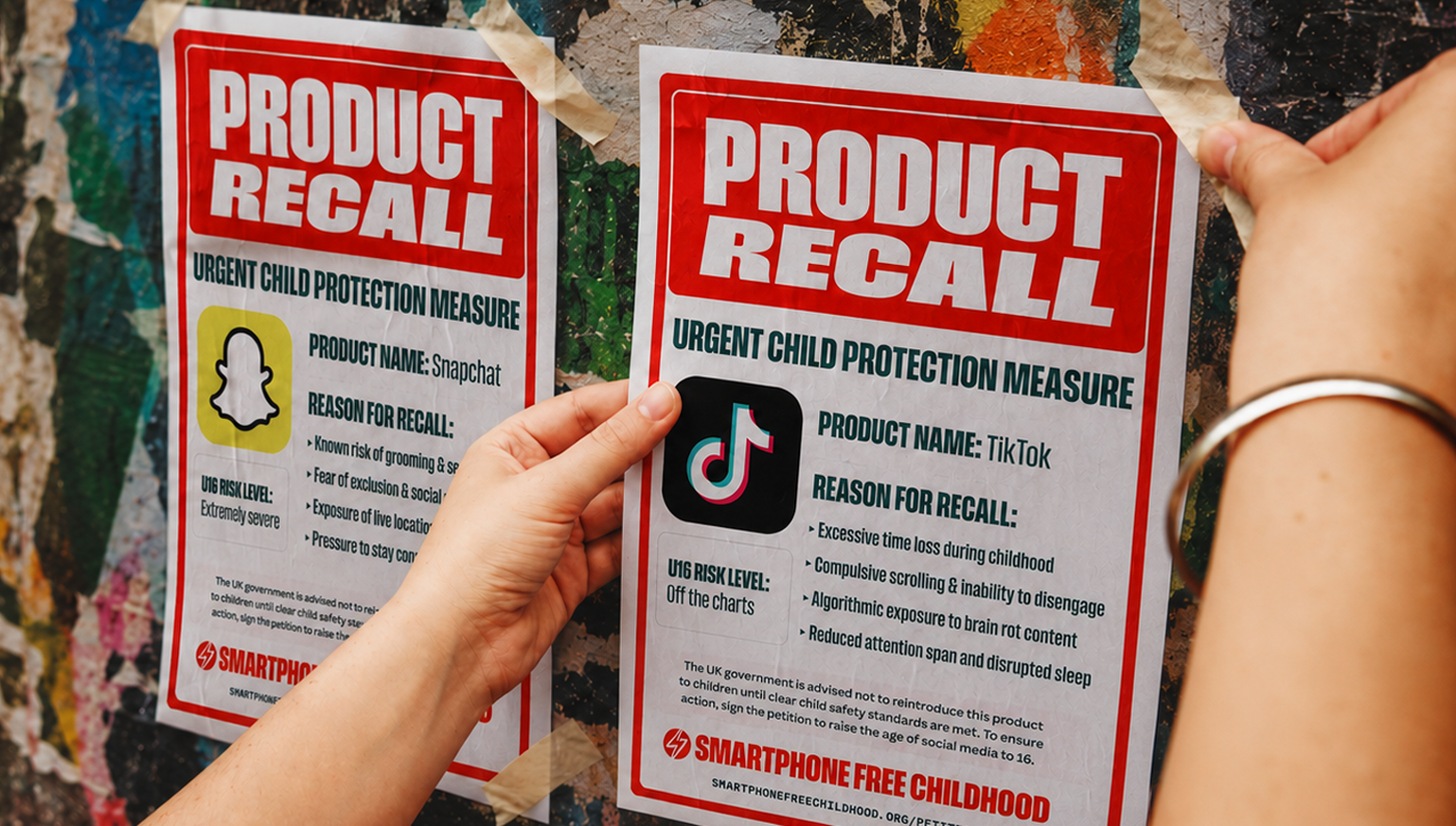
Think of it like the online equivalent of a product recall.
If a product is unsafe for children, it should not be allowed to serve them until it has been fundamentally redesigned.
That idea is now moving firmly into the mainstream – and we think that matters.
None of this means the work is done. But it does mean the centre of gravity is shifting, the pressure on Government is growing, and we’re getting closer to a world where children’s safety comes before Big Tech’s profits.
Below are the full coalition principles and the joint letter sent to the Prime Minister.
Coalition principles
1. Safety before access
Technology companies must earn the right to offer services to under-16s by meeting strict safety standards. Those that fail to meet them should not be permitted to serve children.
2. Fix the design, and the content
Children must be protected from risky, harmful and addictive design features as well as harmful content. These features are design choices, and they can be changed.
3. Platforms must take responsibility
Platforms must be held responsible for preventing harm and restricting underage access to their platforms, rather than expecting parents to do this for them.
4. Strong enforcement, not voluntary promises
Safety standards must be backed by robust regulation and meaningful enforcement, with consequences that companies cannot simply absorb as a cost of doing business.
5. Children should benefit – safely
Children should be able to benefit from the online world, but only in environments that are demonstrably safe and designed for them.
Joint letter to the Prime Minister
To Keir Starmer,
Too many of the technology platforms that our children use every day were not built with their safety or wellbeing in mind. They were built to keep them scrolling, watching and coming back for more. That leaves children and families dealing with the consequences.
We are asking you to act now to require tech platforms to meet strict safety standards to continue to offer their services to under-16s.
We believe a binary debate between banning children from social media or not can over simplify what is a complex issue. Instead, platforms’ continued ability to offer accounts and services to children should be made conditional on their ability to demonstrate that they are safe.
Strict standards must protect children from harmful design as well as harmful content. That means removing risky features like contact from strangers, disappearing messages and live location sharing and ending addictive features like endless scrolling, autoplay, harmful algorithmic feeds, streaks and notifications.
A mechanism must be put in place so that this can be applied to any new feature that puts children at risk or exploits their attention.
This proposal should be seen as a foundational step in a broader programme of reform. We need age restrictions, better regulation of platforms, and comprehensive digital literacy programmes for children and adults.
This consultation is an opportunity to deliver the real change that children, parents, and British families across the UK are calling for.
We urge you to seize it – and to stick to your pledge to act ‘within months not years’.
Yours sincerely,
- Smartphone Free Childhood
- NSPCC
- Molly Rose Foundation
- People Vs Big Tech coalition
- FlippGen